Monday, 24 October 2011

More on the church building . . .


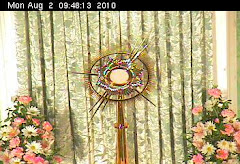
Our altar at St Ann's with the empty tabernacle behind. Taken on Holy Saturday just before the Easter Vigil.

Here's a little follow-up to my last post on the Sanctuary lamp:

The Altar

The altar is one of the most important parts of a church and is frequently situated on an elevated area called the sanctuary or ‘holy place’. Of course the sanctuary had a more clearly defined area before the removal of the altar rails. It is in this ‘sacred place’ on the altar where the ‘sacrament of sacraments’ is celebrated, the holy sacrifice of the Mass. The altar is also the table of the Lord to which all are invited, as one family around the family table (Catechism of the Catholic Church 1182).

The Tabernacle

This is also holy because the Lord who is present in the Blessed Sacrament is kept here to foster adoration of the faithful. (CCC 1183)


The Chair

The Chair of the Bishop or Priest should express his office of presiding over the assembly and of directing prayer. (CCC 1184)

The Ambo/Lectern

The dignity of the Word of God requires the church to have a suitable place for announcing this message so that the attention of the people may be easily directed to that place during the Liturgy of the Word.

I hope some readers find these little snippets of information helpful. It's easy to assume that everyone is familiar with the terminology of the Church and understands the meaning of the signs and symbols that some of us take for granted.

Monday, 17 October 2011

The Sanctuary Lamp . . .


I'm always very happy to try and answer questions raised by parishioners. One of our young parishioner posted a question about the sanctuary lamp on my last post and here is a brief explanation. I hope he or she finds it helpful, and that it might also be of interest to other readers.

In the Old Testament we read in Exodus (27: 20-21) that God commanded that a lamp filled with the purest oil of olives should always burn in the Tabernacle.

“You are to order the sons of Israel to bring you pure olive oil for the light, and to keep a flame burning there perpetually. Aaron and his sons are to set this flame in the Tent of Meeting, outside the veil that is before the Testimony. It must burn there before the Lord from evening to morning perpetually. This is an irrevocable ordinance for their descendants, to be kept by the sons of Israel.”

In Judaism, the sanctuary lamp is known by its Hebrew name, ner tamid (נר תמיד), which means "eternal flame or light".

It is to be found in front of the ark in every Jewish synagogue. It represents the menorah (branched candlestick) of the Temple in Jerusalem as well as the continuously burning fire on the altar of burnt offerings in front of the Temple. It also symbolizes God's eternal presence, and is therefore never extinguished.

The General Instruction of the Roman Missal in the Catholic Church, states (in 316): "In accordance with traditional custom, near the tabernacle a special lamp, fuelled by oil or wax, should be kept alight to indicate and honour the presence of Christ." The sanctuary lamp is placed near the tabernacle as a sign that the Blessed Sacrament is reserved or stored there.

It is a mark of honour to remind the faithful of the presence of Christ, and is a profession of their love and affection. It signifies Christ, as this material light represents He who is the "true light that enlightens all men" (John 1:9).

It is also used by some churches of other denominations to represent the presence of God and may also be found in Eastern Orthodox Churches. Other Christian denominations burn the lamp to show that the light of Christ always burns in a sin-darkened world.

Sanctuary lamps are usually red and may be in the form of a lamp hanging near the tabernacle or, as at St Ann’s, fixed to a bracket on the wall. The red glass container holds a candle that will burn for approximately one week and is never extinguished, the new candle being lit from the used candle it replaces.

Most of this information and more detail can be found on Catholic Encyclopedia and Wikipedia.

Saturday, 1 October 2011

Reverence . . .


Here is a short piece I was prompted to write for next week's newsletter . . .

THE CHURCH

The church is a sacred place where each of us has the privilege of sharing in God’s life and where we shape our lives with God. A ‘sacred place’ means that it has been set aside for the worship of God and for the reception of the sacraments.

The church is not like any other public space; it is not like a hall, a cinema or a theatre. Everything here, that is the art, the architecture, the images communicate one thing – namely, this is a sacred place where God is present.

We belong here, this is our church; laity and clergy alike. The one thing that is required from each of us is RESPECT. That’s why, for example, we are asked to observe an attitude of prayer and silence in God’s house.

The red sanctuary lamp burns day and night indicating that Jesus, God’s only Son, is present in the tabernacle.

Let us renew our love and respect for God’s house and remember, we are in His presence when we come into the church.

Tuesday, 13 September 2011

It's all going swimmingly here . . . !


I don't know how it's going where you are, but the New Translation is going very well here.

I think introducing the texts gradually over a few weeks earlier in the year with a short explanation in our parish newsletter has helped, and also introducing the New Translation for the weekday Masses during the week leading up to the 'launch' on Sunday 4th September has been beneficial too.

Of course, we still make mistakes from time time, both in the pews and in the sanctuary but that is only to be expected with anything new. I don't think it's my imagination but I feel that the natural 'slips of the tongue' are slowly becoming fewer.

Personally, I'm now impatient to receive the full Missal and look forward to seeing the New Translation of the texts for Advent. It will be good too to have a 'proper Missal' on the altar rather than the rather flimsy interim version.

Thank you to all in the parish who have helped to make the transition from the 'old translation' of the Missal to the new go so smoothly.

Friday, 26 August 2011

New Translation of the Missal - A Poll . . .

I came across this excellent poll on the implementation of the New Translation of the Missal and I hope The American Papist doesn't mind that I've taken his questions (slightly modified) to ask readers here how they feel about the imminent introduction of the New Translation.

Originally, I had hoped to set up the poll directly on our Facebook page but couldn't find an easy way of making it anonymous. I think most people prefer anonymity, and as I really would like people to take part, I decided to post it here first and then copy it to Facebook.


What do you think about the New Translation of the Missal?


I'm eagerly awaiting it's implementation.


I'm cautiously optimistic.


I haven't made up my mind yet. I need to wait and see how I feel after a while.


I have some reservations. I'm happy with the current translation.


I'm strongly against it.


Make you own poll at anonvote.com

See Results

If you're having difficulty registering your vote above, you can go directly to the same poll and vote here.

Friday, 19 August 2011

Some of our choir, enjoying a well-earned break . . .

I recently received this lovely photo of some of our choir members enjoying a meal out in Brighton on their annual outing.

I'm very grateful for all that our choir do throughout the year to enhance our liturgies, not just at Sunday Masses but at funerals, weddings and on other occasions too.

They have a break from their regular duties during August and enjoy a well-earned rest. Even so, they kindly made a 'special appearance' at Mass last week to help us celebrate the Feast of the Assumption in style.

We look forward to welcoming them back in September.

Wednesday, 17 August 2011

Papal Visit - Young People's Reunion . . .


Our Diocese is arranging a reunion for all of the young people in our diocese who attended one of the Papal Visit events last year, or who took part in World Youth Day this year.

I know some of our young people did go along to the Papal Visit event in London and Birmingham so I hope you might think about going along.

It will be an evening of

'faith, fun, food, friendship and music'

at St Francis Primary School Southgate Drive, Crawley RH10 6RP
(Next door to DABCEC).

Friday 16th September: 5 - 10 pm

If you are interested in attending please contact ray.mooney@dabnet.org or lucy.jardine@dabnet.org